Our former pride
The Gold of Princes – Royal Representation in Transylvania
The traveling exhibition, realized through the professional cooperation of the Hungarian National Museum, the Csíki Székely Museum, the Museum of Applied Arts and the Money Museum, was presented to the public in Transylvania and in Târgu Mureș in 2024, and in spring of 2025 in Budapest at the Hungarian National Museum.
In the middle of the 16th century, Hungary was divided into three parts and from one of these parts a new state — the Principality of Transylvania — emerged on the map of Europe and along with it a new ruler appeared on the power spectrum. The state and its leader, the prince, used the means of representation to show the wealth and political power of their country. The aim of the deservedly popular exhibition was to present the representation of power of the Transylvanian princes, primarily through the coins they minted, complemented by the elements that can also be observed in the depiction: coats of arms, weapons, armour and various insignia of power, as well as various goldsmith works, which sometimes served as currency.
Throughout history, the image of the prince has played a prominent role in the representation of power of the rulers of each era. In early modern Europe, the portrait of the ruler could be seen in paintings by the political elite, in printed engravings by the wider nobility and the bourgeoisie, and in the portraits on coins by most of the society.
Since the princes regularly minted new coins after coming to power – with their own portraits, thus expressing the legitimacy of their power – these objects can also be considered the first official portraits of the rulers in their iconography. In addition, the coins issued play a very significant role in the depictions of the Transylvanian princes, because they are among the rare depictions of the rulers made in the territory of the Principality of Transylvania. Thus, the portraits on the coins can be considered the most authentic depictions of the Transylvanian princes.
The exhibition introduced the material culture of the aristocracy of the Principality of Transylvania along a previously undeservedly neglected, but all the more interesting theme. The exhibition presented a collection and treasures that were first seen in Transylvanian museums in this selection, and then, due to the great interest, the public could also see them at the Hungarian National Museum between March 15, 2025 and April 13, 2025.
Awakening Nations, Emerging Currencies – A Selection of Coins from Andrássy’s Europe
The temporary chamber exhibition “Awakening Nations, Emerging Currencies – A Selection of Coins from Andrássy’s Europe” held at the Andrássy Castle in Tiszadob presented a selection of coins from Andrássy’s Europe, which was on display from November 2024 to May 2025.
The temporary exhibition commemorated Gyula Andrássy, Sr., Foreign Minister of Austria-Hungary (between 1871 and 1879), and the builder of the castle. Historiography usually sees the peak of his foreign affairs career as the organization of the Berlin Congress of 1878. This congress reorganized and stabilized international relations in the Balkans, which is why its diplomatic significance was enormous in its time. The material, which lists 50 coins (including 28 gold coins), took turns listing the gold and metal coins of all the great powers and smaller states whose representatives were part of the Congress of Berlin and whose fate was decided by the congress.
The participating great powers: Austria-Hungary, the German Empire, the Russian Empire, the Ottoman Empire, the British Empire, the French Republic and the Kingdom of Italy – they were represented in the exhibition by pairs of gold coins. The small states involved, participating as observers: Romania, Greece (already independent), Serbia and Montenegro.
Through the coins, the exhibition shared details about the complex economic historical relations of Southeastern Europe in the 1870s and 1880s, and presented the aesthetics of these new national currencies. In the case of the coins of each smaller state, the primary currency and its promissory note were also displayed. The exhibition made it possible to track when each of the countries in the region launched the establishment of its own national bank and coinage, and presented currencies and money issuers that were novel at the time.
The coin selection also gave visitors an insight into the Hungarian and international significance of a key diplomatic event.
“From Kossuth Banknotes to the Forint” – An Exhibition Showcasing a Century of Currency in Nyíregyháza
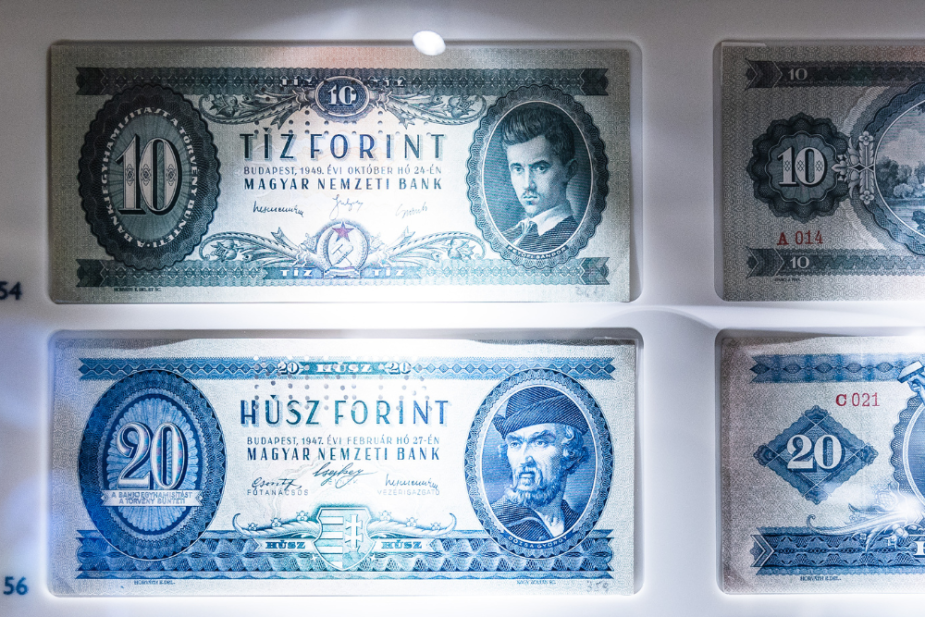
The Kállay House, which houses the Kállay Collection, was built by Dr. Rudolf Kállay, a hospital director whose son Tibor Kállay was the Minister of Finance in the Bethlen government. During his ministry, preparations were made for the establishment of the Hungarian National Bank in 1924. On the occasion of the 100th anniversary of the MNB, a significant temporary exhibition was held in collaboration with the Money Museum to pay tribute to the institution and the person and work of the Minister of Finance Tibor Kállay.
The exhibition material - which was on display between June and September 2024 - presented Hungary's means of payment between 1848 and 1948, including the Hungarian korona banknotes issued in 1923, which also bear the signature of Tibor Kállay.
Among the 158 artefacts loaned by the Money Museum for the exhibition were many special items, from the Kossuth banknotes of the 1848-49 revolution and war of independence to the forint introduced in 1946. In addition to coins, banknotes and minting dies, the exhibition also featured six safes from the Monarchy period, and the exhibition was further enriched by sixteen panels featuring interesting facts from the history of money.
If you would like to get to know the exhibition better, you can view the photos by clicking on the button:
The photos were taken by photographer Lajos Szarka