Hungary after the Treaty of Trianon and the independent central bank
Hungary after the Treaty of Trianon and the independent central bank
As a result of the dissolution of the Austro–Hungarian Monarchy after World War I, the successor countries—including Hungary—had no central bank and no self-issued currency. The economic crisis caused by the war, the skyrocketing inflation of the korona and the relevant urgent need for economic stabilisation required the establishment of a fully independent Hungarian central bank, along with issuing its currency.
As an interim measure, the Hungarian Royal State Note Issuing Institute, established on 11 July 1921, assumed the functions of the central bank, six years after the end of the war and four years after the Treaty of Trianon, Magyar Nemzeti Bank—established a month earlier as a joint stock company—started operating on 24 June 1924. The first president of the bank was Sándor Popovics, a member of the Hungarian Academy of Sciences, while the High Council included Ferenc Chorin, president of the Confederation of Hungarian Industrialists or Fülöp Weiss, the president of the Hungarian Commercial Bank of Pest.
The initially moderate increase in prices led to a loss of confidence in the korona, which had been in circulation since 1892, and this fact, plus the lack of goods and war losses led to skyrocketing inflation. The deterioration of money is reflected in the fact that while 1,000 korona banknotes were equal to 1 gold korona at the beginning of 1923, by the end of 1924, 1 gold korona “cost” 15,000 korona banknotes. The establishment of a new, solid national currency became imperative.
Only a year after the establishment of the MNB, Act XXXV of 1925 provided for the introduction of the new currency, pengő, and all companies, government institutions and private individuals were obliged to adopt it as of 1 January 1927.
No matter how lovely the name pengő sounded, it was basically issued as banknotes with gold coverage. 3,800 pengős were covered by 1,000 grams of 24-carat gold (996/1000), i.e. 1 pengő was covered by 0.26316 grams of gold.
Fillér became the subunit of pengő, 1 pengő was equal to 100 fillérs.
One had to exchange old korona to obtain new currency. 1 pengő was equivalent to 12,500 koronas, i.e. 1000 korona was equivalent to 8 fillérs. Certainly, the exchange of currency did not happen overnight or within a few days, as a result, both the old korona and the new pengő were accepted upon payment for several weeks.
The hyperinflation after World War II resulted in the devaluation of the pengő, like the korona earlier, as a result, it was replaced by forint after two decades, as of 1 August 1946.
Interesting facts:
Pengő used to be the name for silver coins in previous centuries, while gold coins were called csengő. The latter was considered upon the birth of the new currency, but even the name turul was among potential ones.
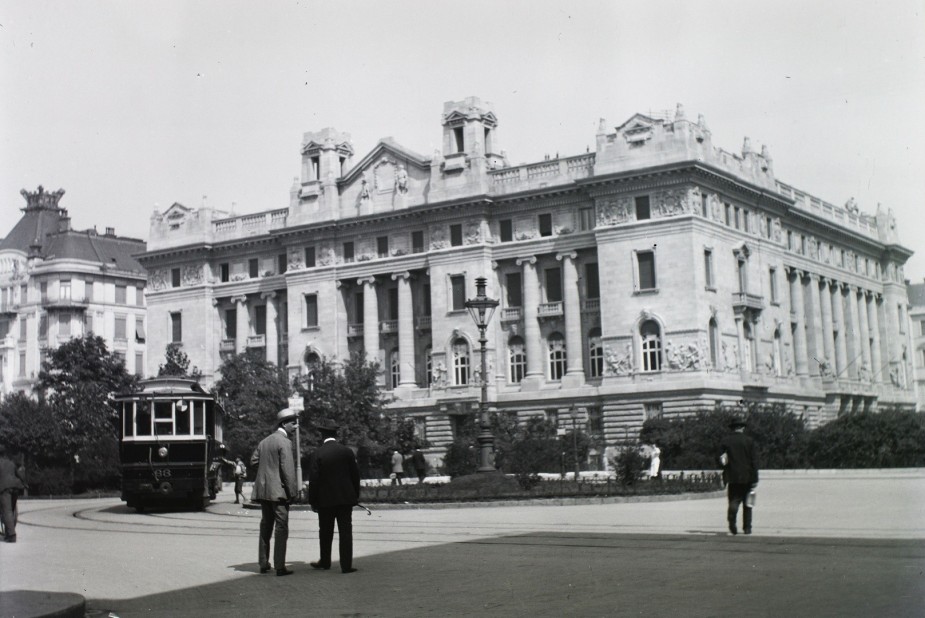
Budapest, the building of theAustro–Hungarian Bank on Szabadság square with a tram, 1907 | Fortepan / SCHMIDT Albin